
Why the Last Mile Breaks Most Robotics Startups with Roland Siegwart, Professor at ETH Zurich
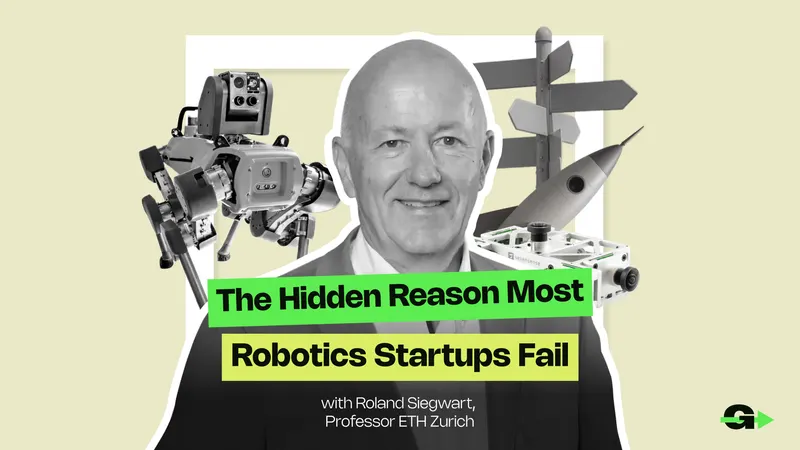
🎙️ ETH robotics pioneer Roland Siegwart on getting from research to revenue
· 908 words
Melanie Gabriel & Christian Woese
January 15, 2026 • Read time: 3 minutes
Dear hustlers, founders, operators and visionaries,
Today’s guest is Roland Siegwart, Professor of Autonomous Systems at ETH Zurich, who initiated ETH’s robotics master program and helped catalyze dozens of deep tech spin-outs in robotics and autonomous systems. He has been at ETH since 2006 and has been directly involved in shaping funding structures, talent programs, and company formation long before teams formally incorporate.
🎧 Tune in now on Spotify, Apple, YouTube and share your thoughts! In the meantime: Follow the Gradient and stay tuned!
PS: Has this e-mail been forwarded to you? Sign up here.

Why you should listen
You should listen to this if you are building deep tech or robotics and feel the tension between long development cycles and the pressure to scale fast.
As the conversation unfolded, it became clear why early revenue, painful market focus, and leadership changes matter more than vision alone in hardware-heavy companies.
What we talk about
00:00 Introduction
03:51 How Switzerland built a self sustaining robotics ecosystem
05:02 Turning university research into real world companies
07:39 Why Europe struggles to scale deep tech globally
09:46 Funding strategies for long hardware driven timelines
12:16 The painful gap between lab prototypes and products
14:09 Early signals that founders can survive the transition
15:37 Finding a first market with real customer pain
19:00 When pilots turn into scalable robotics businesses
20:47 Bringing business leadership into technical teams
23:24 When founders must step aside to let companies grow
31:49 Navigating dual use and ethical responsibility in robotics
Our main take away’s
Deep tech fails when capital replaces urgency: Siegwart argues that abundant early VC in Switzerland reduced pressure to find paying customers, which later exposes startups that optimized for grants and awards instead of revenue.
Hardware startups must plan for a 10x effort gap after the prototype: He explains that moving from proof of concept to market-ready systems often takes at least ten times more resources, with the last 10 percent of product readiness consuming as much time as the first 90 percent.
Early revenue constrains ambition but increases survival: Siegwart consistently favors reaching a few million in turnover and approaching break even before the next funding step, even if it delays the original big vision.
Founders become bottlenecks when leadership is ignored: He highlights repeated cases where technically dominant founders had to step aside as CEO because leadership deficits slowed hiring, investor trust and execution at scale.
Europe’s advantage is systems depth, not speed: Robotics companies build full hardware systems with long validation cycles, which limits rapid scaling but creates defensible value that pure software ecosystems struggle to replicate.
How to reach out to Roland
Exclusive from Roland
What’s a moment where most robotics founders make a decision too late and what would you tell them to do six months earlier?
Quite often startups and also established companies spend too much time on "theoretical" evaluations, instead of just taking a decision and learning on the fly. In many situations, only the concrete implementation will give you the information needed for moving forward.
In robotics, what kind of technical debt is acceptable early on and what kind of debt becomes dangerous later?
Technical debts are typically only getting visible with implementations and testing with early adopter clients. Therefore, it is most often better to fail sooner in order to succeed faster.
What is one blind spot you consistently see in highly technical founders that they rarely notice themselves?
Deep-Tech startups out of University typically continue to follow their ultimate vision instead of focusing on the customer's needs, which enable them to realize short term traction and revenues.
If you could add one missing ingredient to the Swiss or European robotics ecosystem that would materially help founders, what would it be?
VCs that understand the complexity of robotic and are ready to enter a long-term journey for scaling startups over a timespan of over 10 years.
What helps technical founders detach their identity from a specific role or title as the company grows, without losing motivation or ownership?
Early team developments that enable your entrepreneur to understand where the can have the best impact for the company and where they are most excited to work on. It should not be about the title, but about the impact they can make!
What is success for you?
Clients that are willing to pay because you offer them a great added value.
What books, podcasts, articles inspired you?
What inspires me most is the daily work with very talented and dedicated young entrepreneurs that learn fast.
What’s one advice, founders should actually ignore?
Don't go with advisors that tell you their generic stories, but with experienced people that have skin in the game and are ready to invest in your company.
What are habits, activities or rituals that keep you sane?
Team and customer first! Be ready to take harsh decisions on non-performer and no collaborative customers that will not bring you further.
What is one “growth hack” that you see has a positive impact on a startup?
Strong focus on the right hiring and right early adopter customers that are willing to share some risks with you.

Follow the Gradient is a weekly newsletter and podcast by the serial founders Melanie Gabriel & Christian Woese about how to build a business from Europe while staying sane.