
Why Hiring Fast Is the Most Expensive Mistake Founders Keep Making
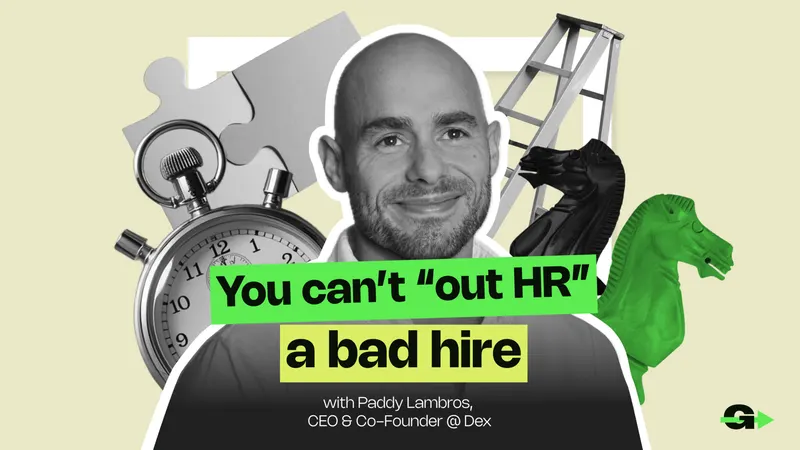
🎙️ Dex CEO and ex-Atomico Talent Partner Paddy Lambros on why rushed hires compound dysfunction
· 981 words
Christian Woese & Melanie Gabriel
February 12, 2026 • Read time: 3 minutes
Dear hustlers, founders, operators and visionaries,
We are releasing the video of our conversation with Paddy Lambros today, former Talent Partner at Atomico and Co-Founder of Recruiting platform Dex. Paddy scaled Improbable from 50 to 650 people across multiple international offices and later helped Sensat grow from 30 to 100 employees. He is a major voice in the ecosystem on Recruiting topics.
🎧 Tune in now on Spotify, Apple, YouTube and share your thoughts! In the meantime: Follow the Gradient and stay tuned!
PS: Has this e-mail been forwarded to you? Sign up here.

Why you should listen
You should listen to this if you are weighing hiring speed against hiring quality and feel the pressure to “just add people” to solve today’s problems.
As the conversation unfolded, it became clear that most startup pain does not come from lack of headcount but from compromised hiring decisions that compound over time.
What we talk about
00:00 Introduction
02:49 The journey from startup to VC
05:19 Hiring slower versus scaling at all costs
07:01 Deciding early roles from first principles
08:39 Attracting talent without brand or budget
11:40 Clarifying your employer value proposition
14:04 Structuring the hiring funnel like sales
17:56 Using case studies and workshops effectively
20:51 Evaluating hunger and long term potential
24:04 Onboarding for time to first value
26:44 Holding a high bar during probation
29:56 Executing layoffs with clarity and focus
35:56 Founder evolution and role layering over time
Our main take away’s
Rushed hiring decisions compound into structural problems. The way you solve today’s gaps becomes the foundation for tomorrow’s organization, and a misaligned hire will cost more time and energy than waiting weeks for a great one.
The first 20 hires define the company’s trajectory. Quality tends to degrade as organizations scale, so if the initial bar is not exceptionally high, culture, accountability, and performance erode quickly as headcount grows.
Recruiting must be treated as a risk reduction process, not a search for validation. Instead of looking for reasons to say yes, founders should qualify candidates out, test real work through collaborative exercises, and close processes within two weeks because time kills deals.
Onboarding is a performance test from day one. If a new hire does not build trust and create tangible value within the first weeks, it is rarely a temporary dip, and founders who extend probation out of empathy often multiply future damage.
Layoffs require decisive surgery, not incremental cuts. Acting too late or too small shortens runway and triggers a talent death spiral, while a single clear reset combined with transparent communication and recommitment of the remaining team preserves trust and momentum.
How to reach out to Paddy
Exclusive from Paddy
What is one thing that everyone knows about startups, but nobody is talking about?
Startups aren't for everybody. They should be for anyone, but they're not for everybody. And when you build an organization, when you build a startup, you're looking for those crazy pirates, those people that are going to come and join you and they're gonna work super hard and they're gonna do things that just a regular employee wouldn't do.
How do you balance hiring for skill versus culture fit? So are there times when one should take precedence over the other?
Think of skill as minimum viable. Everyone can learn skills. That's why they're called skills, but you can't check and you cannot change the fundamental character of a human being by the time they get to you. You can teach them skills, so if you hire someone who's got great skills but they're a terrible fit, I promise you it won't work out.
But I have seen many times people that have a great fit for the team, a great appetite to learn, a great desire to learn new skills. The more senior you go in an organization, the more skills do become important when you're hiring.
But I think that if I had to pick, I would take attitude and I would take principles over everything else.
What's the one key metric to measure health in your talent strategy?
I would want to have a conversation after a year of someone being with us. This is not a metric that exists, but this is just how I think about it. If you were given the choice to rehire this person or to go out and find someone, what would you do? Would you stick or twist? And I think if people are like “Yeah, they're OK” in that situation, I think that's a problem. And I don't know how you phrase that: What proportion of your team do you think is absolutely flying?
There's a thing called Spencer's law: The value created by a team is driven by the square root of the size of the team. So at any point, there is a fraction of your team that is delivering the vast majority of the value. Your job as a founder is to identify that group of people, to understand what makes them that group of people, and to hire as many people of that type, of that character, of that ability, whatever it may be that makes them amazing, as many of those people as humanly possible, and to minimize the number of people that aren't that.

Follow the Gradient is a weekly newsletter and podcast by the serial founders Melanie Gabriel & Christian Woese about how to scale a business from Europe while staying sane.
You have full control over what we send to you. We sent a weekly rundown on Tuesdays, and our podcast brief on Thursdays. If you do not want to receive this Thursday one, you can change this in the email preferences below.