
How to protect your mental health
A self-assessment for individuals who suspect they're running on fumes
· 1,866 words
Christian Woese & Melanie Gabriel
February 09, 2026 • Read time: 6 minutes
Working in Startupland can be incredibly rewarding but also bring you to a breaking point. The fear of not fulfilling the expectations your team or co-workers have of you? The feeling of not knowing what on earth you are doing here, although your LinkedIn network celebrates you for "building the next big thing"?
"I do not know a single successful person who was not struggling with mental health." This is what serial entrepreneur Adrian Locher told us in our conversation with him. Adrian started his first company at 14. By the time he was running his career at his peak, he was logging 120 flights a year, building two companies in two time zones, and pushing harder because that was the only gear he knew. Until everything collapsed: his marriage ended, he missed the birth of his second child, and he hit what he describes as the lowest point of his life.
But Adrian rebuilt. Not by grinding harder, but by going inward. He got a therapist. He built a framework. And he fundamentally changed how he operates.
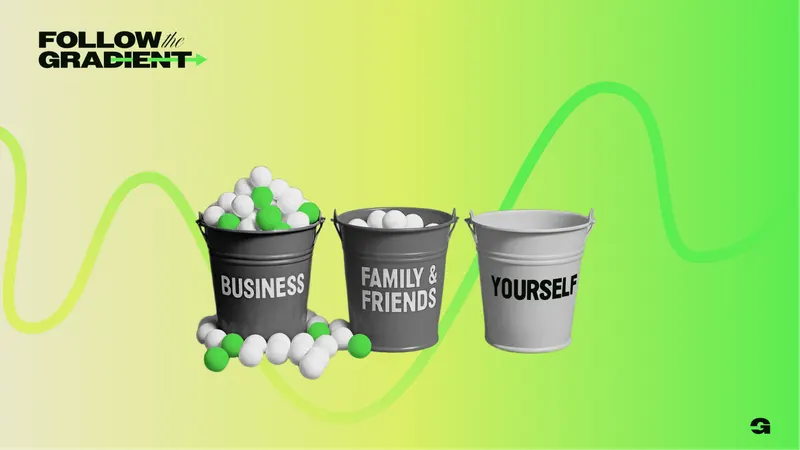
The core of that framework is dead simple. He calls it The Three Buckets.
How the Three Buckets protect your mental peace
Adrian learned this concept in therapy, and it stuck because it doesn't require a self-help book to understand.
Your life has three buckets:
Business: your company, your work, the thing that probably consumes 80-100% of your waking hours right now.
Family & Relationships: partner, kids, friends, the people who matter but keep getting rescheduled.
Self: your physical health, mental health, the things that actually recharge you. Not Instagram. Not "I'll sleep when I'm dead." The stuff that makes you a functioning human.
The insight isn't that these three areas exist. You know that. The insight is this:
If you're only filling one bucket, the other two don't wait patiently. They drain.
Most founders reading this already know which bucket they're neglecting. The question is whether you'll do anything about it before you have your own version of Adrian's story.
Ready to do your own energy?
What follows is an exercise. It will take a level of honesty that might be uncomfortable. No scoring system, no gamification, just questions that force you to look at what's actually happening in your life right now.
If you're the kind of person who reads frameworks and thinks "interesting" but never applies them, this is where you stop. If you're ready to be honest with yourself, keep going.
The Three Buckets Exercise
This is not a "rate your life satisfaction 1-10" exercise. That's too easy to game and too vague to be useful. Instead, answer these questions honestly. Write your answers down, not in your head, on paper or in a doc. The act of writing forces clarity. Especially in times of AI. All this is for you, no one else. You are your own judge.
Bucket 1: Business
Where does the energy actually go?
Describe your last typical workweek in concrete terms. Not the idealized version, what actually happened. How many hours? How many of those hours were high-leverage vs. reactive firefighting?
Which of these hours, or meetings, gave you energy, which ones drained energy?
When was the last time you did deep, focused work on something strategic, not urgent, but important? If you can't remember, that's your answer.
Are the tasks consuming most of your time truly important for the long-term direction of your company, or are they urgent-but-small tasks that keep you busy but don't move the needle? Are you spending time on work that only you can do, or are you caught up in things someone else could handle because letting go feels uncomfortable?
Who depends on you for decisions that someone else could make? Write their names. Now ask yourself: are you holding onto control because it's needed, or because letting go feels like losing?
What's the cost?
When you're "off" in the evening or on weekends, are you actually off? Or is your mind still running the company? Be specific: when was the last time you went a full day without checking Slack or email?
Have you cancelled personal plans for work in the last month? How many times? Did the work actually require it (ask yourself: what would have happened, if you had not cancelled your personal plans and not attended to work matters at that time)?
Bucket 2: Family & Relationships
Where does the energy actually go?
Think about the last week. How many uninterrupted hours did you spend with the people who matter most to you? Uninterrupted means phone away, not half-listening while scanning your inbox.
When you're with your family or friends, do they get the full version of you, or the leftover version? The one who's physically present but mentally still in the last meeting?
Name one person close to you who has subtly or directly told you they need more from you. What did you do about it?
What's the cost?
Adrian talks about the guilt loop: at work, you feel guilty about not being with family; with family, you feel guilty about not working. Does this loop run in your head? How often?
If your partner, kids, or closest friend described your availability over the last 3 months, what would they honestly say? Not what you hope they'd say. What they'd actually say.
Bucket 3: Self
Where does the energy actually go?
What do you do that is purely for you, not for the company, not for the family, just for your own recovery and well-being? List the activities. Now check: when was the last time you actually did each one?
Adrian found that meditation, philosophy, sports, and skiing are what genuinely recharge him. Not performatively, genuinely. What genuinely recharges you? (If you don't know, that's a significant data point.)
How's your sleep? Not "fine", actually describe it. How many hours? Do you fall asleep easily or lie there running through tomorrow's problems? Do you wake up rested?
What's the cost?
When was the last time you took a proper break, not "working from a nicer location" but actually disconnecting? How long ago? How long did it last?
Would you describe your current energy level as sustainable for the next 12 months? Be brutally honest.
Putting it together
Look at your answers across all three buckets. Now answer this:
Which bucket is overflowing?
Which bucket is dangerously low?
What would need to change, concretely, this week, to move even 10% of your energy from the overflowing bucket to the empty one?
Adrian's concrete move: 5-9pm became non-negotiable family time. No meetings, no calls, no email. The bar for interruption is "the house is on fire." After 9pm, he may be back online. This one boundary changed everything, not because of the hours, but because it eliminated the guilt loop.
What's your version of 5-9pm?
The Warning Signs Checklist
Adrian says he didn't recognize the signs until it was too late. Looking back, they were obvious. Here's a checklist drawn from his experience and what we've heard across dozens of founder conversations on this podcast.
Check every statement that's true for you right now
☐ Your sleep has degraded: falling asleep is harder, or you wake up and can't stop thinking about work
☐ You're more irritable than usual: shorter fuse with your team, your partner, your kids
☐ You catch yourself in negative thought spirals: catastrophizing, ruminating, replaying worst-case scenarios. As Jonas Muff in our conversation put it: "Founders don't suffer from failure or rejection, but from imagining it."
☐ You've stopped doing the things that used to recharge you (exercise, hobbies, time with friends), not because you chose to, but because "there's no time"
☐ You feel guilty no matter what you are doing: guilty about not working when with family, guilty about not being with family when working
☐ Your travel schedule or work hours have crept up without a conscious decision. It just happened
☐ You tell yourself "it's just this quarter" or "once we close this round", and you've been saying that for more than 6 months
☐ Taking even a few hours fully off feels impossible because you believe you are the only thing standing between the company and disaster
☐ Your sense of self-worth has become indistinguishable from how the company is performing. When the company struggles, you feel like a failure as a person
☐ The dominant emotion behind your work has shifted from excitement or purpose to fear: fear of failure, fear of irrelevance, fear of being found out
☐ You have a growing sense that the people around you don't understand, aren't pulling their weight, or are working against you, when they probably are not
How to read this
0-2 checked: You're managing. But keep this list somewhere you'll see it in 3 months. Things change fast.
3-5 checked: Pay attention. These are the early signals. This is your window to act before it gets worse. Talk to someone: a coach, a therapist, a founder who's been through it.
6+ checked: This is not sustainable and you likely already know it. The only question is whether you address it now or after a crisis forces you to. Adrian's advice: seek help. Therapy is not weakness, it's the same as hiring a coach for your business. You wouldn't try to scale a company without advisors. Don't try to manage your mental health alone either.
We've run three highly inspiring conversations with leadership coaches which walk through frameworks to better cope with the responsibility a leadership person faces:
Stanislaw Grunstein on why most startup leaders fail and how to grow into the role
Jake Bornstein on coaching founders through chaos and on radical responsibility in leadership
What Now
This audit isn't meant to be a one-time exercise. Adrian checks in with his three buckets regularly. The warning signs list is something you can revisit monthly. It takes 2 minutes and it surfaces what you're too busy to notice.
Two things Adrian said on the episode that are worth sitting with:
“My biggest strengths are also the biggest dangers to destroy myself, and they're inherently linked.”
The relentless drive that makes you successful is the same force that will break you if left unchecked. You can't eliminate it. You can learn to manage it.
“If I cannot move outside, then maybe I need to move inside.”
Going inward isn't a retreat. For driven people, it's the hardest thing you'll ever do, and the most productive.
Listen to the full conversation with Adrian Locher, "Serial founder Adrian Locher on the moment grind turns into collapse". Available on Spotify, Apple Podcasts, and YouTube.
Want more like this? Subscribe to our channel on Youtube or Spotify. Practical insights on scaling a business from Europe while staying sane. Twice a week, no fluff.

Follow the Gradient is a weekly newsletter and podcast by the serial founders Melanie Gabriel & Christian Woese about how to scale a business from Europe while staying sane.