
The Most Dangerous KPI in Startup Life | Adrian Locher
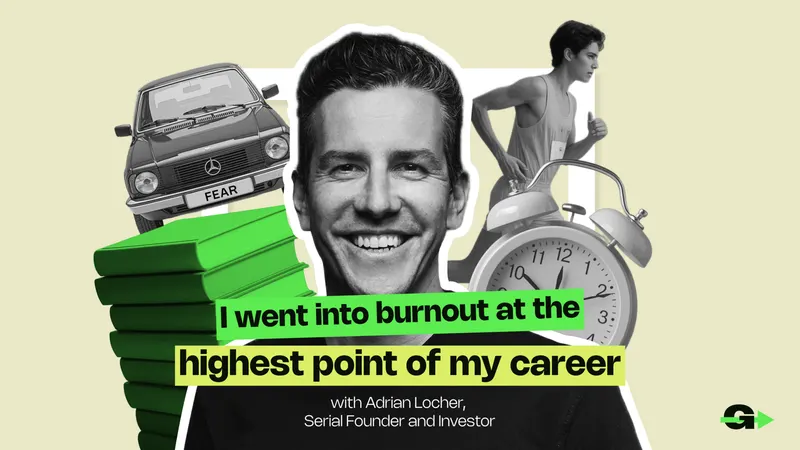
🎙️ Serial founder Adrian Locher on the moment grind turns into collapse
· 1,075 words
Christian Woese & Melanie Gabriel
February 05, 2026 • Read time: 4 minutes
Dear hustlers, founders, operators and visionaries,
We are releasing the video edition of one of our most popular conversations today: Our talk with Adrian Locher, Partner at Merantix, who built and exited multiple companies and now backs founders at the earliest stages. He operates as a hands-on investor, working closely with portfolio CEOs from day one.
🎧 Tune in now on Spotify, Apple, YouTube and share your thoughts! In the meantime: Follow the Gradient and stay tuned!
The concept of the Energy Audit of Adrian is pure gold to get through tough moments in your life. Get it here.
PS: Has this e-mail been forwarded to you? Sign up here.

Why you should listen
You should listen to this if you believe sustained high performance requires constant pressure and availability.
As the conversation unfolded, it became clear where ambition turns into self-destruction and what actually breaks first when founders ignore recovery.
What we talk about
00:00 Introduction
03:52 Burnout at the peak of founder success
05:26 Ignoring early symptoms until everything stops
12:56 Therapy and structuring life around three buckets
20:09 Building companies as a marathon, not a grind
23:49 Leading through authenticity instead of toughness
28:06 Fear as a hidden driver of overperformance
32:25 Helping yourself before helping the company
33:58 Mentoring founders to avoid the lowest lows
37:48 Redefining success beyond money and status
Our main take away’s
Burnout often peaks after success, not failure. Locher hit depression after an exit while starting two companies in different continents and taking 120 flights in a year, showing that external momentum can mask internal collapse.
Founder strengths scale into founder risks. The same traits that drove Locher’s success pushed him into burnout because intensity and fear were left unmanaged, not reduced, as scope increased.
Ignoring recovery destroys leverage over time. Treating entrepreneurship as nonstop competition without recovery led to lost family relationships and total paralysis, proving output eventually drops to zero.
Clear boundaries reduce guilt rather than ambition. By enforcing non-negotiable family time from five to nine and moving work later, Locher removed constant context switching that had made both work and family worse.
Teams follow behavior, not statements. Mental health became actionable in his portfolio only when founders modeled recovery themselves, reducing stigma and increasing trust under pressure.
Additional material on the topic
Founder wellbeing report 2024 by Balderton that was mentioned by Melanie
“Entrepreneurs are 2 times more likely to suffer from depression, 3 times more likely to suffer from substance abuse, and 10 times more likely to suffer from bipolar disorder” - the study Adrian mentions from where he’s gotten these numbers is from 2015 by Michael A. Freeman et. al and has the title Are Entrepreneurs touched with fire?
How to reach out to Adrian
adrian@merantix.com
Exclusive from Adrian
What’s one mental habit or mindset shift that immediately helped you reduce stress or make better decisions under pressure?
Meditation immediately helps me to clear my head for first principles thinking, which in most cases is my preferred way making important decisions. I’m always trying to be data-driven, while leaving a lot of room for intuition on the “last mile” of decision making.
What are the top 3 tools, apps, or systems you use daily to manage your workload and mental wellbeing?
Zero inbox on all relevant channels applying a simple method of classifying incoming items in
1) can be resolved within 30 seconds, so do it directly
2) can be done best by someone else, so I delegate
3) needs my involvement, so I snooze it for a deep work session
Three more helpful rules I try to stick to: avoid desk or meeting lunch, nature walk meetings, avoid “back to back” days.
Are there any books, podcasts, or frameworks that have helped and inspired you?
My all-time favourite reads:
Trillion Dollar Coach: The Leadership Playbook of Silicon Valley's Bill Campbell; Eric Schmidt & Jonathan Rosenberg.
The Core. Better Life, Better Performance; Aki Hintsa.
Scaling People: Tactics for Management and Company Building; Claire Hughes Johnson.
What You Do Is Who You Are: How to Create Your Business Culture; Ben Horowitz.
Love, Freedom, and Aloneness: The Koan of Relationships; Osho.
Do you have any specific habits or rituals (e.g., morning routines, journaling, exercise) that help you maintain focus and energy throughout the day?
My ideal morning routine that I achieve in I’d say in 4 out of 5 days: Do a first sweep of my inboxes while grabbing my first coffee. Workout and/or meditation follows. The rest of the morning is dedicated to my kids with breakfast and uninterrupted conversations during the drive to school. Energy hacks during the day: no food before lunch (healthy, mostly avoiding high carb), no sugar/sweets, no coffee after 2pm, super short 2-3 mins meditation sessions before important meetings. Evening routine: If the workout didn’t happen in the morning, I also really enjoy doing it after coming home as it helps me to clear my mind. Family dinner is a fixed ritual and I usually don’t take calls/meetings between 5 and 8pm. After that I’m available again, which especially the founders in our portfolio enjoy in case longer and deeper conversations are needed.
What’s your approach to saying “no” to opportunities or tasks that don’t align with your priorities, especially when you’re under pressure to keep growing?
Politely declining and stating the honest reason in the cases where the person asking made an effort. Not replying if the request is rather random and seems untargeted.
What advice would you give to first-time founders about preparing for the psychological challenges of entrepreneurship?
It’s great to maintain a little naivety and a dose of overconfidence. If you’d always know in advance what expects you, sometimes you probably wouldn’t start it. Don’t be afraid to seek help when things get nasty. Take inspirations from others, but figure out what really works for you.
What changes would you like to see in how the startup ecosystem supports founders’ mental health and long-term wellbeing?
It’s all there. Use it and seek help if things you try don’t work out. Speak up and out. Then share your story and inspire others.

Follow the Gradient is a weekly newsletter and podcast by the serial founders Melanie Gabriel & Christian Woese about how to build a business from Europe while staying sane.