
Why “Wait and See” Is a Losing Strategy for European Founders
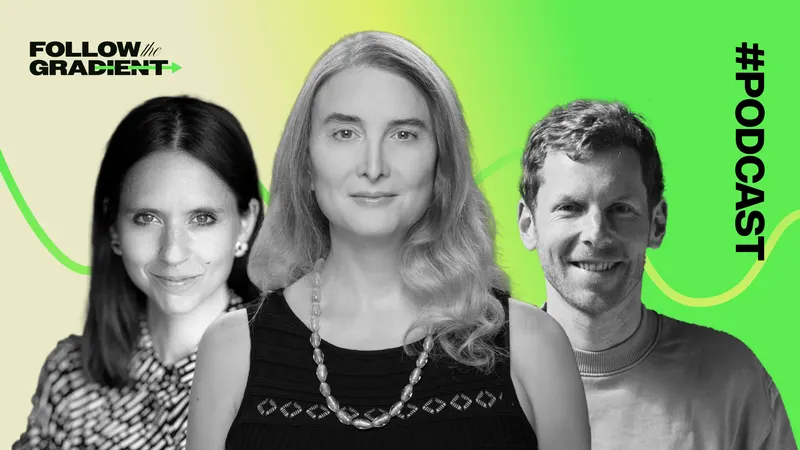
🎙️ Zattoo's Founder Bea Knecht on what Europe gets wrong about startups
· 1,195 words
Melanie Gabriel & Christian Woese
December 18, 2025 • Read time: 4 minutes
Dear hustlers, founders, operators and visionaries,
Today’s guest is Bea Knecht, serial founder and founder of live-TV streaming service Zattoo. Bea has seen startups succeed and fail across radically different ecosystems. She has a rare ability to explain why some founders hit product-market fit while others stall.
🎧 Tune in now on Spotify and Apple and share your thoughts! In the meantime: Follow the Gradient and stay tuned!
PS: Has this e-mail been forwarded to you? Sign up here.
Why you should listen
You should listen to this because this episode explains why the biggest risk isn’t being wrong, but refusing to update, and how you can avoid falling into the same trap.
It became clear to us very early in the episode: this talk is going to be different. Bea is a true out-of-box thinker with contrarian views.
What we talk about
02:07 - Why thinking about internationalization is key for European startups
11:59 - Why non-technical founders are underrated
24:31 - Why female founders should be represented much more
29:32 - Why starting a company is easy but scaling is hard
Our main take away’s
Execution in chaos is a competitive advantage: Founders in fast-moving markets like Asia are forced to act before the path is clear. This teaches them to execute while learning, a mindset European founders often lack due to over-structuring and under-hustling.
Internationalization is a built-in constraint for Swiss startups: Because the Swiss market is too small to sustain long-term growth, founders must prioritize going global from the beginning. This forces a focus on scalable go-to-market strategies, but too many teams remain blind to this necessity.
Waiting to act on truth is not caution, it’s failure: In Bea's view, Silicon Valley isn’t brave; it’s simply fast at recognizing and acting on what’s true. European startups often fall behind because they delay action until certainty arrives, by which point it’s too late to lead.
Social sciences produce underestimated startup leaders: Non-technical founders, especially those from liberal arts or teaching backgrounds, are often undervalued, but they bring the chaos-management, communication, and empathy skills that startups desperately need. Bea argues that the best leaders often emerge from outside the tech core.
Most decisions will be wrong and that’s okay: Bea emphasizes that 95% of what founders do will turn out to be suboptimal. The point is not to avoid mistakes, but to stay flexible and open to change, even after public decisions have been made.
True “must-haves” scream when you take them away: If a product goes offline and no one notices, it's a nice-to-have. But if the world panics (like with AWS), it’s a must-have. That’s the litmus test Bea uses—and one she thinks too many startups fail to apply soon enough.
Women aren’t a diversity checkbox, they’re essential operators: Beyond fairness, Bea argues women bring unique perspectives, higher emotional stability, and critical insights into how half the population lives and works. Including them isn’t optional if you want to build for the real world.
How to reach out to Bea
Exclusive from Bea
One decision-making heuristic to judge whether a market is ready now or only in five years?
I look for “embarrassing pull.”
If serious, competent people are already doing slightly embarrassing or hacky things to solve the problem—manual workarounds, spreadsheets, duct-taped APIs—the market is now.
If everyone agrees the problem is real but nobody is embarrassed yet, it’s probably five years out.
In 2005, users were pirating streams, downloading clunky video players, patiently enduring buffering—they were already bending their lives to watch video and TV online. That’s the signal I built into with Zattoo. Now, I observe viewers losing track of what’s happening nationally in politics and culture because they’re completely lost in their social media bubble. I think there’s space for a company to lean into that and reconnect people with their national culture using TikTok like brevity with day-fresh video material from vetted sources.
One red flag in the founder–operator dynamic that predicts scaling trouble?
When the founder confuses control with insight.
If the founder must be in every decision and can’t explain the decision logic clearly, scale will stall.
Great operators don’t just decide fast—they make their reasoning legible so others can execute independently.
Opacity scales badly.
One habit to stay intellectually honest (truth over wishful thinking)?
I force myself to write the “uncomfortable memo.”
A short note answering: If this fails, why will it have failed—and what part will be my fault?
Writing exposes self-deception faster than thinking.
If I can’t write it cleanly, I don’t yet understand reality.
One structural change that would immediately boost global-scale European startups
Create a truly pan-European growth market.
Not more seed money—Europe already has that.
What’s missing is frictionless scaling across borders: procurement, data, labor, stock options, media rights.
Europe funds innovation nationally but expects companies to scale continent-wide. That mismatch kills momentum.
Fix the market, not the founders. The EU’s 28th regime is unifying the legal framework for the incorporation of startups (by inventing a virtual 28th member of the EU in which startups can be incorporated under one common rule).
One intervention in schools/universities to produce more (especially female) founders?
Teach real ownership early.
Give students responsibility for something that can fail publicly: a budget, a product, a publication, a venture.
Women are often over-trained in excellence and under-trained in risk with visibility.
Founders are made by agency, not by confidence workshops.
What is success for you?
Having built things that outlive my direct involvement—without betraying my values or myself.
Success is continuity with integrity:
that my work, my leadership, and my personal truth don’t cancel each other out over time.
What books, podcasts, articles inspired you?
I gravitate toward systems and clarity
“The Information” by Jessica Lessing
Shelly Palmer’s Newsletter
I avoid anything that promises certainty.
What’s one advice, founders should actually ignore?
“Just focus on growth.”
Unqualified growth advice destroys more companies than it creates. Focus on why growth works, where it compounds, and what it breaks. Scale magnifies flaws faster than strengths.
What are habits, activities or rituals that keep you sane (while scaling your business)?
Movement, solitude, and clean structure.
Physical movement to reset cognition
Solitude to hear my own thinking
Written structure to reduce emotional noise
If my calendar or inbox starts thinking for me, I intervene immediately.
One “growth hack” with outsized impact (business or personal)
Relentless simplification.
Every quarter I ask: What would I remove if I had to halve the system?
Progress often comes from subtraction, not addition—fewer products, fewer metrics, fewer narratives.
Clarity compounds faster than cleverness.

Follow the Gradient is a weekly newsletter and podcast by the serial founders Melanie Gabriel & Christian Woese about how to build a business from Europe while staying sane.