
Why execution is now the true differentiator with OpenAI's Laura Modiano
🎙️ OpenAI’s Laura Modiano on why three-week cycles quietly died for serious founders
· 791 words
Christian Woese & Melanie Gabriel
January 22, 2026 • Read time: 3 minutes
Dear hustlers, founders, operators and visionaries,
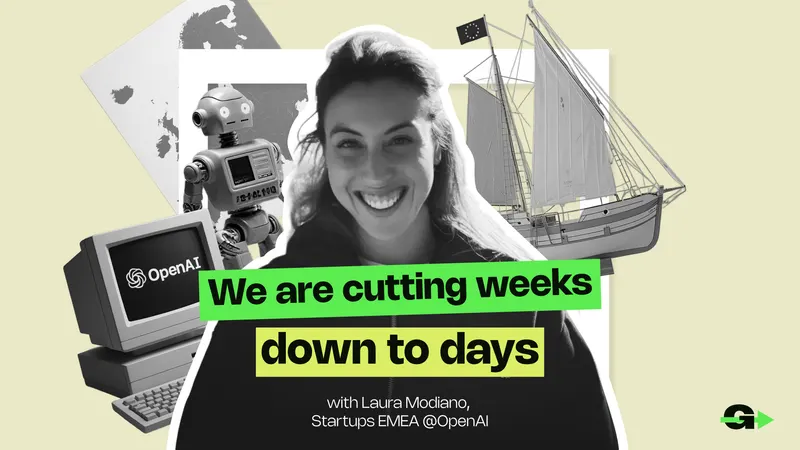
Today’s guest is Laura Modiano, Head of Startups EMEA at OpenAI, who works directly with founders scaling AI application layer companies across Europe, the Middle East, and Africa. She supports startups from idea to fundraising by partnering on product, feedback loops, and go-to-market execution at scale.
🎧 Tune in now on Spotify, Apple, YouTube and share your thoughts! In the meantime: Follow the Gradient and stay tuned!
PS: Has this e-mail been forwarded to you? Sign up here.

Why you should listen
You should listen to this if you are building an tech company in Europe and feel the tension between faster tools and slower execution habits.
As the conversation progressed, it became clear that collapsing build cycles only create advantage if founders unlearn stage-specific processes before they harden at scale.
What we talk about
00:00 Introduction
02:03 Why Europe Produces Globally Competitive Founders
06:07 What Founders Miss About AI Acceleration
08:52 Building Real Companies Beyond Demo Culture
12:09 Why Technical Depth Wins In AI Startups
15:42 What Switzerland Gets Right About Ecosystems
20:01 Deciding Where To Build In Europe
23:01 What Strong Execution Looks Like Today
26:10 Discovering AI Use Cases Beyond Cost Cutting
28:55 Why Unlearning Becomes A Scaling Advantage
31:26 Maintaining Founder Intensity Without Burnout
41:40 Making High Stakes Decisions With Incomplete Data
44:57 Where Startups Should Focus As Models Advance
46:41 False Beliefs Holding European Founders Back
Our main take away’s
Europe’s advantage is execution under fragmentation, not capital parity. This is true because founders must design for multiple regulations, languages, and buyers from day one, which forces global-ready architectures earlier. At scale, this constraint compounds into faster international expansion than single-market startups.
AI has collapsed build cycles, but execution quality now breaks companies. Sprints that used to take weeks now take days, which increases the cost of unclear product intent. At 10x speed, shipping without a reason amplifies waste instead of progress.
Technical depth is no longer optional for AI application founders. This is true because close feedback loops with model providers require founders who can test, eval, and integrate continuously. Without this capability, teams fall behind each model release and lose iteration leverage.
Most founders unlearn processes too late, not too early. What works at MVP stage fails at 100 employees because culture, decision rights, and tooling harden prematurely. The consequence at scale is organizational drag that no amount of model improvement can fix.
New value sits in customer-facing use cases, not internal efficiency alone. Startups focused only on productivity gains compete directly with improving base models. Companies that open entirely new customer capabilities create expanding markets instead of shrinking margins.
How to reach out to Laura
Exclusive from Laura
How can startups work most effectively with OpenAI at different stages: from idea, to early traction, to real scale? What do founders consistently get wrong about this?
We at OpenAI startups team are always available and you can reach us directly or through your investors. We partner on technology first and see ourselves as enablers. We measure our success by the ability of founders to launch fast, build value through their startups, and their ability to succeed.
You often talk about ambition as something that needs to be defined and revisited. In practice, what does “great ambition” look like in a founder and how do you distinguish it from vague or performative ambition?
Founders who want to scale globally from day 1, who think about value creation across a use case or vertical, rather than single steps in a process, who are not afraid to tackle big problems and can create a platform for growth for their companies.
You’ve said that founders who give strong, direct feedback tend to move faster and get more leverage. What does great feedback actually look like in practice and what kind of feedback gets ignored?
Continuous evals and testing. As the models improve and change and new use cases are created, make sure you stay on top of it to let us know where we should continue to invest and improve.
What books, podcasts, articles inspired you?
I listen to Lenny’s Podcast and Stratechery and like to scan X and LinkedIn.
What’s one advice, founders should actually ignore?
How others did things. What works for one company, team, founder, culture are not always right for another.
What is one “growth hack” that has a positive impact on you or the company?
Networking.

Follow the Gradient is a weekly newsletter and podcast by the serial founders Melanie Gabriel & Christian Woese about how to build a business from Europe while staying sane.