
Google Search deemed a monopoly
plus: How to structure your pricing page
· 728 words
Christian Woese & Melanie Gabriel
August 13, 2024 • Read time: 4 minutes
Dear hustlers, founders, operators and visionaries,
In a move that echoes the wild growth-at-all-costs era, AI wearable start-up Friend just spent $1.8m of its $2.5m in funding on the domain name friend.com. They’re working on an “AI necklace” that’s always with you, listening to everything— think: a modern Tamagotchi. Is it just us, or is that a bit creepy? Their product better be good — famous tech reviewer Marques Brownlee recently called a similar AI wearable the worst product he has ever tested. Want to take a leap of faith? You can pre-order your “Friend” for $99, but we suggest reading the Terms & Conditions first. Was that $1.8m well spent? Follow the Gradient and stay tuned.
PS: Has this e-mail been forwarded to you? Sign up here.
Your talk track for this week’s cocktail party
Anduril raises $1.5bn
Defence tech start-up Anduril just closed a whopping $1.5bn round, bringing its valuation to $14bn. This comes only seven years after being founded by Palmer Luckey, former Oculus founder and a controversial figure himself. This sky-high valuation highlights the VC industry's growing appetite for defence tech, especially since Russia’s war with Ukraine. It follows the recent $487m Series C round of German defence firm Helsing, with venture investments in the sector growing massively, hitting $34.9B in 2023.
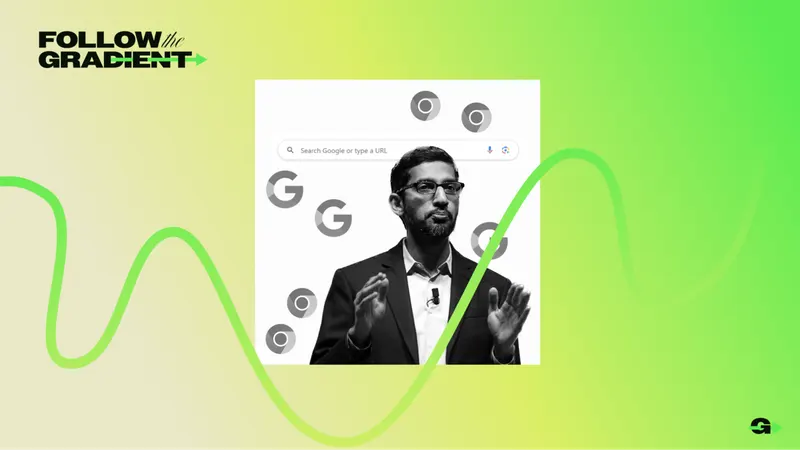
Google Search deemed a monopoly
A US federal judge ruled that Google’s search dominance violates competition law. Google pours billions each year into exclusive deals with browser developers and device makers to secure its default search engine spot—$20bn to Apple alone in 2022—effectively stifling competition. While Google plans to appeal, this case could drag on for years, potentially shaking up the industry—especially for Mozilla, which depends on Google for 80% of its revenue.
More leaders leaving OpenAI
OpenAI is facing another leadership shakeup. Co-founder John Schulman has left for rival Anthropic, co-founder Greg Brockman is on an extended leave, and product leader Peter Deng has also departed. This adds to the growing list of senior exits following November's leadership crisis, when CEO Sam Altman was briefly ousted by the board before being reinstated. Now, only two of the original 11 founders, Altman and Wojciech Zaremba, remain at OpenAI. While turnover is common at startups, the recent wave of high-level departures is raising concerns about Altman’s ability to retain top talent as power increasingly consolidates in his hands.
A world of memes

Food for thought
50% of a founder’s time goes to people-related topics
Many founders are surprised to find that after launching a minimum viable product (MVP) and securing venture funding, most of their time rapidly shifts to hiring, HR, and managing people:

The epiphany for me has been realizing that building a great company relies most on leveraging people rather than strategy. Successfully opening a new office isn’t about analyzing a budget spreadsheet—it’s about who will lead it.
One good read
Note: Don't have an Economist account? Reply to this email—we have a few credits left to gift you the article!

Do you like what we do at Follow the Gradient? Help us grow this community and share a like and add a comment to our LinkedIn post that just went live:
No must-attend events in Europe this week*
Enjoy the calm before the (event) storm; September will be here soon enough.
Why not use the time to reach out to journalists that are covering your space? And ask them to meet in the event you’re planning to attend in September? Cate Lawrence, senior writer at tech.eu just posted on LinkedIn that she is especially keen to learn from startup founders that are super-early stage. This is the sign you’ve been waiting for!
*Did we miss one? Let us know by replying to this email.
Smart hack
Don't reinvent the wheel with your pricing page. Stick to a standard format for clarity.
✅ Good pricing pages boost positioning, clarify value, ease sales, and increase conversions.
❌ Bad ones confuse, frustrate, and drive prospects to competitors.
B2B marketing expert Emily Kramer shared a helpful template with all the necessary points - make use of it!
